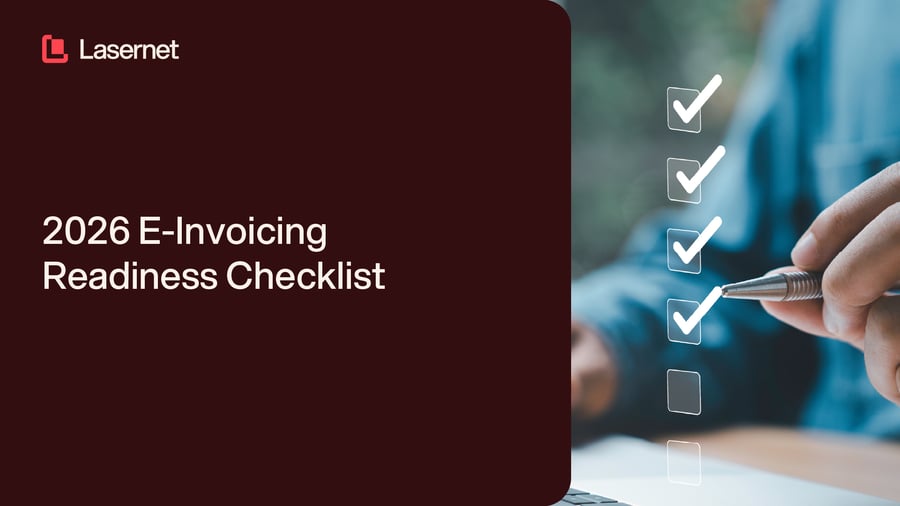
Organisations that handle the transition to e-invoicing well tend to start earlier than they think they need to, not because the technology is unusually complicated, but because the internal work takes time to bear fruit. If you’re in this camp, but you’re not sure how to best prepare, you’re in the right place.
Here’s how you need to be preparing for fast-approaching e-invoicing mandates in 2026:
1. Know your legal obligations and identify compliance gaps
Start by examining what is required of your organisation in each jurisdiction where you operate, and when you need to be ready. This sounds straightforward, but in practice it means mapping your invoice flows against a regulatory landscape that varies significantly by country, entity size and sector.
Bear in mind that regulations are changing quickly. Alongside our 2026/27 e-invoicing mandate guide, some of the most reliable sources to consult are the relevant tax authority’s website, or, in the case of EU Member States, the European Commission’s e-invoicing country factsheets.
Once you know what is required, compare it against your current processes. Do you have gaps in format capability, data completeness or archiving that need attention before the deadline comes into effect? If your billing and accounts receivable processes aren’t already standardised and well-documented, that is the first task to focus on, as you can’t accurately assess a gap you haven’t fully mapped.
2. Assess your current invoicing setup
With your regulatory obligations clear, the next question is whether your existing systems can actually meet them.
- Can you generate structured XML or UBL invoices?
- Can your ERP produce the mandatory data fields required by each country?
- Can you easily migrate invoicing data across back-office functions like accounting and billing?
- Can you connect to the required exchange networks or clearance platforms, or do you need an Access Point provider?
You may already be able to accommodate these regulatory changes. However, if your organisation still relies heavily on paper-based processes, it’ll be necessary to invest in new e-invoicing software to meet your regulatory obligations.
There’s more to it than structured formats
Keep in mind that generating an e-invoice in a valid format is only part of the e-invoicing mandates. In countries like France and Belgium, for example, the delivery network or approved platform is a core part of the mandate, not an optional delivery method. Confirm whether your chosen solution handles certified routing, not just format generation.
Identifying process and data issues
For many organisations, this assessment phase also surfaces broader process issues that have nothing to do with the mandates themselves, such as manual steps that breed errors, duplication or data quality problems that may cause validation failures at the point of submission. These are issues worth fixing regardless of the compliance timeline.
The more consistent your data, the easier it is to reliably generate structured formats. A single document layer, rather than engineering multiple country-specific builds, reduces duplication and long-term maintenance tasks as the number of jurisdictions you operate in grows.
Plan for exceptions
It’s wise to plan for exceptions from the very start. Rejections, credit notes, duplicate invoices and partial deliveries are the reality of e-invoicing, not just edge cases. Make sure your chosen e-invoicing solution tracks statuses and makes corrections manageable – inbox monitoring and manual follow-up don’t scale well.
3. Choose the right e-invoicing partner
The provider you choose matters more than you may initially realise. The immediate question is whether a solution meets your current technical requirements: structured format generation (aligned with EN 16931 for EU Member States), ERP integration, Access Point connectivity and of course, compliance with relevant mandates. But there’s also the matter of keeping up with inevitable future regulatory changes.
E-invoicing regulations are in constant flux
The last few years have shown that e-invoicing regulations are far from static. New mandates are confirmed regularly, existing ones are updated and strengthened, and ViDA will reshape the cross-border picture significantly by 2030. An e-invoicing provider that actively tracks regulatory change, updates their solution ahead of deadlines and operates across all the jurisdictions relevant to you should be your goal.
Avoiding an expensive rebuild when new requirements arrive
An architecture that already supports API-driven exchange and validation logic will also accommodate future e-invoicing requirements without requiring a rebuild. As near-time reporting expands under ViDA, your invoice data will feed directly into regulatory reporting – plan for that now rather than retrofitting it later at great cost.
Questions to ask a potential e-invoicing software provider:
- Which countries and mandates do you currently support, and how do you handle jurisdictions where requirements are still changing?
- Do you support all the formats and exchange networks relevant to our business, e.g. UBL, CII, Peppol, etc.?
- Are you an accredited Access Point, and in which jurisdictions?
- How does your solution integrate with our ERP, and what does implementation typically involve?
- What is your documented uptime SLA, and what happens to our invoice flows if the platform goes down?
- How are you preparing for ViDA’s cross-border reporting requirements from July 2030?
4. Pilot early with high-volume, high-risk flows
Before committing to a full e-invoicing rollout, start with the invoice flows that carry the most regulatory and operational risk. Cross-border trade, jurisdictions with clearance or near-real-time reporting requirements, and transactions with complex VAT treatment are generally a good place to begin. It’s not because they're the easiest, but because they are where problems are most costly to discover late on in the process.
A well-designed e-invoicing pilot exposes gaps in your source data before they become live validation failures – missing VAT identifiers or incorrectly formatted tax codes won’t do your organisation any favours. The pilot tests whether your ERP integration produces the correct structured output under real-world conditions and gives your finance and IT teams the chance to work through exception-handling processes before they need to be up and running.
5. Build visibility into your processes
Once your e-invoicing flows are working, the question moves from whether you are compliant to whether you can see what is happening and respond quickly when something goes wrong.
Finance teams need to be able to see the full invoice lifecycle: generation, submission, delivery and platform acceptance or rejection. Without this visibility, the first sign of a problem is a partner chasing payment or, depending on where you operate, a tax authority asking about a missing submission. By this point, the window for a clean and easy resolution has narrowed or even closed.
Near-real-time reporting
As near-real-time reporting requirements expand under ViDA, the audit trail you create becomes even more important. Tax authorities in clearance or continuous transaction control (CTC) jurisdictions already have visibility into your invoice data.
Being able to demonstrate exactly what was submitted, when, and what the response was on your end is good practice. In some jurisdictions, it’s part of the compliance obligation.
Preparing for e-invoicing mandates: The bottom line
By understanding your regulatory obligations in the jurisdictions where you operate, reviewing your current invoicing setup, selecting a suitable e-invoicing partner, piloting early and building visibility into the process from the start, you set your organisation up for e-invoicing compliance without any technical hiccups.
Organisations that work through this checklist will have the operational foundations of e-invoicing in place: standardised data, automated structured exchange and real-time visibility across invoice flows in multiple jurisdictions. The business benefits follow from there: stronger internal controls and a clear audit trail, lower invoice processing costs, faster cash collection, and a foundation that doesn’t need rebuilding every time regulations change.
As global regulations continue to change, the foundation you build now becomes even more valuable over time. That’s where Lasernet’s e-invoicing solution comes in.
Find out how Lasernet allows you to generate, send and track compliant e-invoices anywhere, in any approved format, from one platform by booking a demo via the form below.
FAQs
What is e-invoicing?
E-invoicing is the exchange of invoices in a structured electronic format that the receiver’s system can process automatically.
What is ViDA?
VAT in the Digital Age (ViDA) is an EU package designed to modernise VAT rules. The biggest change for most businesses is near-real-time digital reporting of intra-EU B2B transactions from July 2030, using EN 16931-compliant invoices.
What is EN 16931?
EN 16931 standardises e-invoicing across EU member states to increase efficiency and harmonisation in B2B, B2G and G2G transactions. It establishes a unified semantic data model for e-invoices to ensure interoperability and ease of understanding invoice content regardless of the system used. The standard requires the use of different syntaxes, such as UBL and UN/CEFACT CII.
How does Lasernet simplify e-invoicing?
Lasernet allows you to generate compliant invoice formats directly from your existing systems. Our low-code design tools let you map data, apply business logic and create structured outputs – no custom development required.
Built-in compliance checks ensure every invoice meets the latest standards before it’s sent, reducing the risk of rejection and avoiding time-consuming manual reworks.
What are the benefits of transitioning to e-invoicing?
Organisations that move to e-invoicing early gain access to standardised data, automated structured exchange, and real-time visibility into what is happening across their invoice flows in multiple jurisdictions, stronger internal controls with a clear audit trail, lower processing costs and faster cash collection.
By transitioning to e-invoicing early, your organisation gains a solid foundation that doesn’t need to be rebuilt every time regulations change.