A Guide to E-Invoicing (2026)

What is a E-Invoicing?
What is Peppol 2

E-invoicing is the issuing, transmission and receipt of invoice data in a structured, machine-readable format that lets systems process it automatically.

It is fundamentally different from emailing a supplier a PDF invoice. A PDF is a picture of an invoice, and this means someone still needs to manually enter the details into the ERP/accounting system or trust OCR to do it for them. A structured invoice, on the other hand, arrives as data the system can read without intervention, allowing for automated matching and validation.

E-invoicing is on the agenda for a few reasons:

  1. Governments across Europe, the Middle East, Asia Pacific and Latin America are mandating structured e-invoicing.

  2. More customers are specifying e-invoicing in their supplier requirements.

  3. Teams are building it into ERP rollouts and wider transformation programs. 

Why EInvoicing Takeaway
What is EInvoicing Hero

Key takeaways

  • E-invoicing means sending invoices as structured, machine-readable data, unlike a PDF.

  • EU formats are built on EN 16931, the European standard, which is written in UBL or CII syntax and applied through formats such as Peppol BIS Billing 3.0, Factur-X and ZUGFeRD.

  • E-invoicing mandates vary by country, with more coming into effect every year.

  • The benefits of e-invoicing compliance include lower processing costs, faster payments, more visibility and cleaner data for reporting and tax purposes.

  • A single, ERP-integrated e-invoicing software solution, like Lasernet, will help you stay compliant as new mandates come into effect.

What is E-Invoicing?

In the context of e-invoicing, “structured” means the invoice is made up of labeled data fields. Each value is stored in its own named field, and because every field is labeled to a shared standard, the receiving system knows which value is the invoice number and which is the total amount owed, so it reads and interprets the invoice automatically without anyone having to manually enter the information.
 

E-invoices look very different from other formats:

  • Paper invoices are readable by humans, and someone has to enter the details into their finance system.

  • A PDF is a digital image of an invoice, which makes delivery easier, but the information ultimately still needs to be manually entered into finance systems.

  • Structured XML formats (such as UBL or Peppol BIS) are invoice data that systems read and process directly, with no layout of their own.

  • Hybrid PDF/XML formats (such as Factur-X or ZUGFeRD) combine a human-readable PDF with machine-readable structured data embedded in the same file.

This separation is the whole basis of e-invoicing. Tax authorities, ERP systems and networks such as Peppol read and check the data later, while humans can read the visual rendering. Whether an invoice meets a mandate depends on the structured data being correct and in the required format. 

EInvoicing FO

How does E-Invoicing work?

The best way to show you how e-invoicing works is with an example. The steps below follow an invoice from a supplier’s ERP system to a customer in Belgium, where a Peppol B2B e-invoicing mandate came into effect in January 2026: 

The supplier raises an invoice in their ERP/accounting system. Rather than printing it and posting it to the customer, or saving it as a PDF before sending the invoice in an email, the company’s chosen e-invoicing software formats the data into a structured, machine-readable file, in this case UBL. 


The software checks the invoice against business rules and tax rates, and runs the mandate checks that confirm it complies with Belgium’s e-invoicing rules. 

The e-invoicing software transmits the invoice to the customer across the Peppol network. 


The buyer’s ERP/accounting system matches the invoice to the relevant purchase order and delivery receipts. 

If invoice details match the customer’s purchase orders and receipts, the buyer’s system triggers payment, and the supplier can expect to be paid within the agreed terms. 

Once the invoice is processed and paid, the system files it automatically with the relevant retention policy. In Belgium, e-invoices must be stored for ten years. 

EN 16931

EN 16931 standardizes e-invoicing across EU member states to increase efficiency and harmonization in B2B, B2G and G2G transactions. It establishes a unified semantic data model for e-invoices to ensure interoperability and ease of understanding invoice content regardless of the system used. The standard requires the use of syntaxes, such as UBL and UN/CEFACT CII. 

Term

Type

What it is

Written in

EN 16931 

E-invoicing standard 

The EU standard defining what a compliant invoice must contain 

UBL or CII 

UBL 

Syntax 

An XML language for invoicing data so software processes it automatically 

XML 

CII  

Syntax 

UN/CEFACT’s alternative XML language 

XML 

Peppol BIS Billing 3.0 

Format built on EN 16931 

The e-invoice format for the Peppol network, with Peppol-specific validation rules 

UBL 

XRechnung 

Format built on EN 16931 

Germany's public sector e-invoicing format 

UBL or CII 

Factur-X and ZUGFeRD 

Hybrid e-invoicing format built on EN 16931 

A readable PDF with an XML file embedded, used in France and Germany 

CII 

E-invoicing compliance and mandates in 2026

Is e-invoicing mandatory? The answer to this question depends on where you are in the world. Each country has its own rules and phases the rollout on their own timetables. Whether your business has to comply with an e-invoicing mandate, and from when, depends on where you trade, who you invoice and how large your business is.


To work out where you stand compliance-wise, you need to check the following:

  • The countries you invoice in and whether you hold a VAT registration there.

  • Who you are billing, such as government or other businesses, as most mandates are B2G or B2B.

  • Your company size, as smaller businesses are often given more time to get compliant than larger organizations.

  • The format and route you have to use, for example a Peppol invoice sent across the Peppol network, or a national format filed through a government portal.

  • Whether the tax authority approves each invoice as you issue it, or asks you to report the data separately.

  • How long you have to retain each invoice.


The answers to these questions vary from one country to the next. For example, in Belgium, all VAT-paying enterprises must now send structured Peppol BIS Billing 3.0 invoices to other businesses via the Peppol network. In France, all companies must be able to receive e-invoices from 1st September 2026 onwards, with large enterprises and mid-sized companies being legally required to issue e-invoices from the same date. 

In the UK, however, mandatory e-invoicing for VAT-registered businesses doesn’t arrive until 2029, and the finer technical details are still being discussed at the government level.

Because the rules differ by country, it’s worth checking the current position for each market you operate in. For a full country-by-country breakdown of e-invoicing mandate deadlines, read our 2026 and 2027 e-invoicing mandates guide.

EInvoicing Mandates

The benefits of E-Invoicing 

Compliance is often the trigger for an e-invoicing project, but it isn’t what sustains the investment. Once structured invoicing is embedded in your systems, you start to see its many benefits: 

Automation replaces manual data entry, rekeying, printing, postage and physical archiving, and can bring the cost of processing an invoice down from $12 to $15 to $2 to $4 per invoice.  

51% of UK B2B invoices are currently overdue. Structured invoices help solve this problem because they arrive validated and match automatically against purchase orders, reducing rejections and approval delays. 

Structured exchange tracks each invoice through submission, validation, delivery, acceptance and rejection in near-real-time, giving finance teams a live view of activity, instead of having to chase invoices over email.  


Formats aligned to EN 16931 provide consistency, which improves internal analysis, tax readiness and prepares you for ViDA’s 2030 B2B digital reporting deadline.  

E-invoicing significantly reduces paper usage, postage costs and physical archiving work, providing measurable environmental savings that strengthen sustainability reporting with no additional initiative to manage. 

In markets where structured exchange is already standard, such as Italy, Brazil and Mexico, being unable to send or receive compliant invoices creates friction that gets in the way of commercial relationships. 

E-invoicing vs EDI

The difference between e-invoicing and EDI is in scope. Electronic Data Interchange (EDI) is the machine-to-machine exchange of business documents between trading partners, with data passing straight from one system to another. Retail, manufacturing and logistics businesses have relied on EDI for decades.

E-invoicing covers one document, the invoice, but it has to satisfy requirements EDI wasn’t built to handle. Because tax authorities now use invoice data to have more visibility into VAT, a compliant invoice has to follow a semantic standard (EN 16931 in the EU) that defines required fields. 

It also has to pass validation against that standard and the destination country’s rules, and reach the recipient through the channel that country mandates. In many countries, the tax authority itself receives and approves the invoice, and this is something EDI cannot do. 

EInvoicing VAT

Term

What it is

Common formats/standards 

E-invoicing 

The practice of exchanging a machine-readable invoice between a supplier and a buyer that can be processed by the receiver’s ERP system/finance platform 

XML, Peppol BIS Billing 3.0, EDIFACT, JSON 

EDI 

An automated B2B communication method used to exchange structured business documents securely over dedicated networks 

UN/EDIFACT, TRADACOMS, VDA, UBL 

How Lasernet supports E-Invoicing

Lasernet acts as a single, ERP-integrated layer between your source systems and country-specific e-invoicing mandates. The platform takes your invoice and tax data from within your ERP, whether that’s Microsoft Dynamics 365, SAP, Infor or IFS, and generates, validates, routes, tracks and archives compliant e-invoices, with no change to your wider IT setup.

As Mirion Technologies and ETERNA’s experiences with Lasernet demonstrate, finding suitable e-invoicing software to align with country-specific mandates doesn’t have to mean a complete system overhaul.

Invoice and tax data are mapped once and the correct output is produced automatically for each jurisdiction, meaning teams benefit from consistent business logic across regions. Plus, the low-code design lets you update formats and workflows in-house as mandates change. There’s no need to raise an IT support ticket or get help from an external developer.

Lasernet also complements Microsoft’s Electronic Reporting framework, as the F&O connector builds on ER to manage compliant output, routing and delivery, including to the Peppol network through certified access points.

Next steps toward E-Invoicing
compliance

E-invoicing is structured invoice data, and the format it takes, how it is delivered and the rules it needs to meet vary by country.

The best place to start is by figuring out which transactions are in scope, whether your ERP can produce the required compliant output and how you plan to manage routing and monitoring changing mandates. Lasernet handles all of this from a single platform, generating compliant e-invoices from your existing ERP data across every market you operate in. 

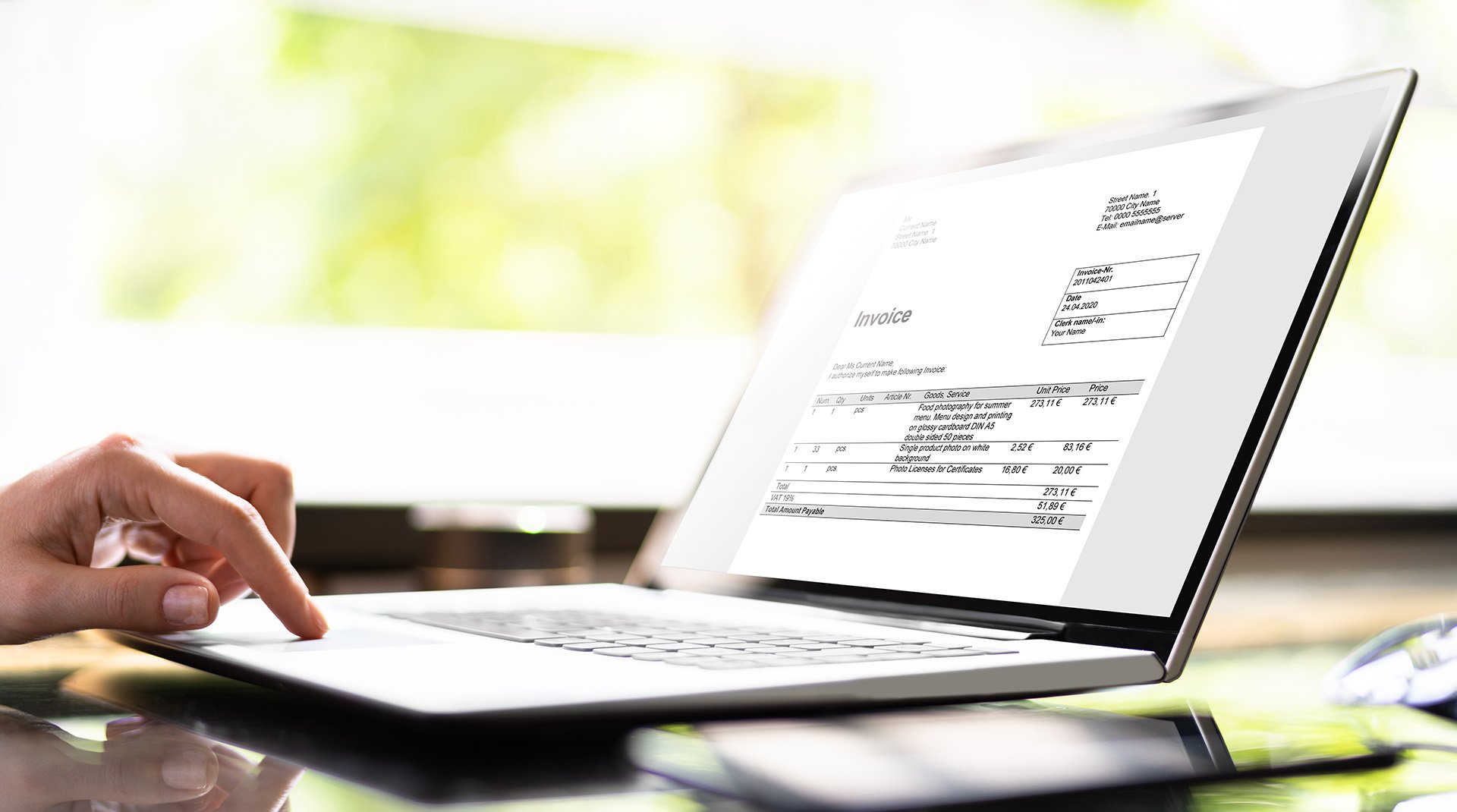
A hand with red nail polish hovers over a laptop keyboard displaying an invoice, next to another screen showing a document.

Frequently Asked Questions about Document Management

No, a PDF is not an e-invoice, but a picture of an invoice. An e-invoice is generated in a structured, machine-readable format that lets ERP and accounting systems process it automatically. 

The supplier’s system creates the invoice as structured data, an e-invoicing platform validates and formats it, and it is transmitted over a network (such as Peppol) to the buyer, whose system reads and processes it automatically. 

Typically structured XML formats built on the EN 16931 standard and written in UBL or CII syntax. Some of the most common are Peppol BIS Billing 3.0, XRechnung, and hybrid formats like Factur-X/ZUGFeRD. 

Electronic Data Interchange (EDI) is the computer-to-computer exchange of business documents, while e-invoicing is the invoice alone and has to meet specific formatting, validation and delivery rules.